



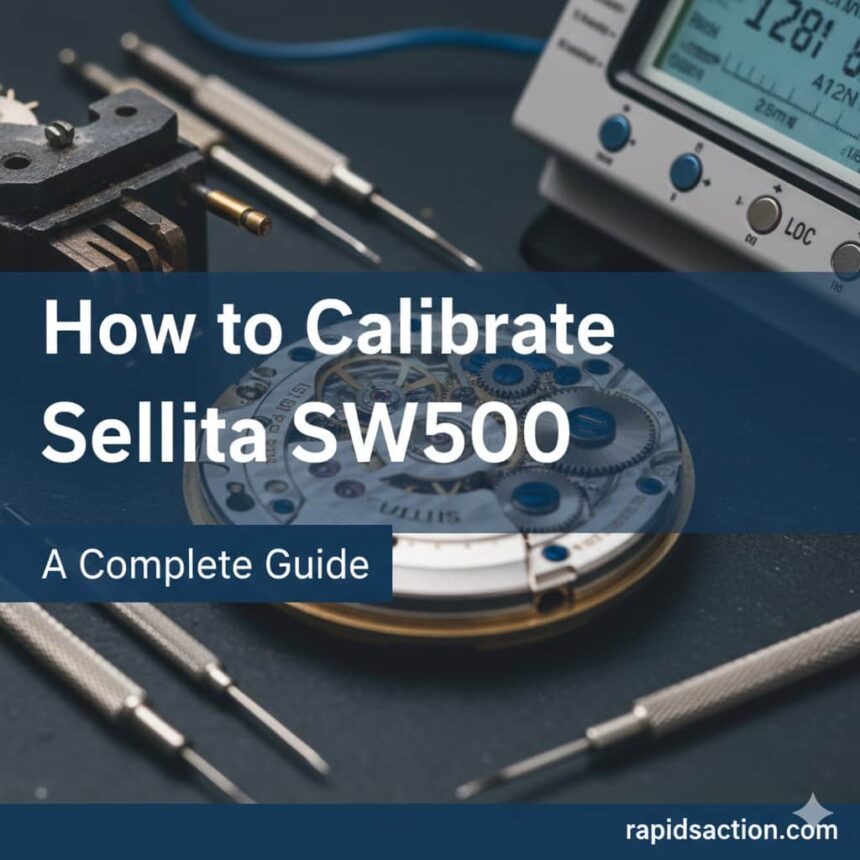
Owning a watch with a quality automatic movement like the Sellita SW500 is a fantastic experience. These intricate machines keep time with impressive accuracy, powered by nothing more than the motion of your wrist. However, over time, even the best movements can drift slightly. If your watch is running a bit fast or slow, learning how to calibrate Sellita SW500 movements can restore its precision. This guide will walk you through everything you need to know, from understanding the movement itself to the step-by-step process of regulation.
- What is the Sellita SW500 Movement?
- Why Does a Watch Movement Need Calibration?
- Essential Tools for Calibration
- Understanding Timegrapher Readings
- How to Calibrate Sellita SW500: A Step-by-Step Guide
- Step 1: Open the Watch Case
- Step 2: Locate the Regulation System
- Step 3: Measure the Initial Performance
- Step 4: Adjusting the Beat Error
- Step 5: Adjusting the Rate (How to Calibrate Sellita SW500 for Accuracy)
- Step 6: Check Other Positions
- Step 7: Close the Case
- When to See a Professional Watchmaker
- Conclusion
- Frequently Asked Questions (FAQ)
Key Takeaways
- Understanding is Key: Before attempting calibration, it’s crucial to understand what the Sellita SW500 is and how it works.
- Tools are Essential: You’ll need specific watchmaking tools like a caseback opener, a non-magnetic tweezer, and a timegrapher for accurate results.
- Patience is a Virtue: Calibrating a watch movement is a delicate process that requires a steady hand and patience. Small adjustments make a big difference.
- Know When to Call a Pro: If you are not comfortable opening your watch or making these fine adjustments, it’s always best to seek a professional watchmaker.
What is the Sellita SW500 Movement?
Before we dive into the calibration process, let’s get to know the star of the show. The Sellita SW500 is a Swiss-made automatic chronograph movement. It’s often called a “workhorse” because of its reliability, durability, and widespread use in the watch industry. It is very similar in design to the Valjoux 7750, another famous chronograph movement, which means it has a proven and time-tested architecture.
The SW500 operates at a frequency of 28,800 vibrations per hour (vph), or 8 beats per second. This high beat rate contributes to the smooth sweep of the seconds hand and the movement’s potential for high accuracy. It typically features 25 jewels, which are synthetic rubies placed at high-friction points to reduce wear and tear, ensuring the movement runs smoothly for years. Understanding these basics gives you a better appreciation for the tiny engine inside your watch.
Why Does a Watch Movement Need Calibration?
You might wonder why a sophisticated piece of Swiss engineering needs adjustment at all. Several factors can affect a watch’s accuracy over time.
- Positional Variance: Gravity affects the watch’s components, especially the balance wheel and hairspring, differently depending on the watch’s position (dial up, dial down, crown up, etc.). A well-calibrated watch minimizes these differences.
- Temperature Changes: The metal parts inside a watch expand and contract with temperature fluctuations. While modern movements use alloys that are resistant to these changes, extreme temperatures can still affect timekeeping.
- Magnetism: Exposure to strong magnetic fields from everyday objects like speakers, laptops, and smartphones can magnetize the hairspring, causing it to stick together and run extremely fast.
- Impacts: A hard knock or drop can jar the delicate balance assembly, throwing off its regulation.
Regular calibration, or regulation, addresses these issues by fine-tuning the movement to keep the most accurate time possible across various conditions.
Essential Tools for Calibration
Attempting to calibrate a watch without the proper tools is a recipe for disaster. You can easily scratch the case, damage the movement, or lose tiny screws. Here is a list of must-have tools for the job.
- Caseback Opener: This depends on your watch case. You might need a friction ball for smooth casebacks, a JAXA-style wrench for notched ones, or a specific screwdriver for cases held by screws.
- Movement Holder: A simple plastic or metal holder will secure the movement once it’s out of the case, preventing it from moving while you work.
- Non-Magnetic Tweezers: You will be working near the hairspring, which is highly susceptible to magnetism. Using brass or anti-magnetic steel tweezers is non-negotiable.
- Screwdriver Set: A set of watchmaker’s screwdrivers (usually 0.6mm to 1.2mm) is needed for any screws you might encounter.
- Loupe or Magnifier: The parts you’ll be adjusting are tiny. A 5x or 10x loupe is essential to see what you’re doing.
- Timegrapher: This is the most crucial tool for accurate calibration. A timegrapher listens to the “tick-tock” of your watch and provides real-time data on its rate (how fast or slow it is), amplitude, and beat error.
Understanding Timegrapher Readings
Using a timegrapher can seem intimidating, but its display is straightforward once you know what to look for. It measures three key metrics.
Rate (s/d)
This is the most important number for our purpose. It tells you how many seconds per day your watch is gaining or losing. A positive number (+) means it’s running fast, while a negative number (-) means it’s running slow. The goal is to get this number as close to zero as possible.
Amplitude (°)
Amplitude is the amount of rotation in the swing of the balance wheel. For a healthy, fully wound SW500, you want to see an amplitude between 270° and 315°. Low amplitude can indicate a need for servicing.
Beat Error (ms)
Beat error measures the consistency between the “tick” and the “tock.” A perfect movement has a beat error of 0.0 milliseconds (ms). Anything under 0.5ms is generally considered excellent for an SW500.
Metric | Ideal Range (for SW500) | What it Tells You |
|---|---|---|
Rate | -4 to +6 seconds/day | The daily accuracy of the watch. |
Amplitude | 270° to 315° | The health and power of the movement. |
Beat Error | 0.0ms to 0.5ms | The symmetry of the balance wheel’s swing. |
How to Calibrate Sellita SW500: A Step-by-Step Guide
With your tools ready and a basic understanding of the process, it’s time to begin. Remember to work in a clean, well-lit area where you won’t lose any small parts.
Step 1: Open the Watch Case
First, you need to access the movement. Carefully examine your watch’s caseback to determine the correct tool to use.
- For a screw-down caseback with notches, use a JAXA-style wrench. Adjust the prongs to fit securely into the notches and turn counter-clockwise.
- For a press-on caseback, you may need a thin case knife to pry it open at a designated lip.
- For a caseback with screws, use the appropriate watchmaker’s screwdriver.
Place the caseback aside in a safe place. You should now see the Sellita SW500 movement.
Step 2: Locate the Regulation System
Look for the balance wheel, which is the part of the movement that oscillates rapidly back and forth. Near the balance wheel, you will find the regulation system. The Sellita SW500 uses an Etachron regulation system. You will see two small levers or “studs” sitting on the balance cock (the bridge holding the balance wheel).
- Regulator Stud: This is the lever used to adjust the daily rate (fast/slow). Moving this lever changes the effective length of the hairspring.
- Beat Error Stud: This stud holds the other end of the hairspring. Adjusting it corrects the beat error.
Step 3: Measure the Initial Performance
Before making any adjustments, you need a baseline. Wind the watch fully (about 40 turns of the crown). Place the watch on the timegrapher sensor in the dial-up position. Let it run for about a minute to get a stable reading. Note the initial rate, amplitude, and beat error. This information will guide your adjustments.
Step 4: Adjusting the Beat Error
It’s best practice to correct the beat error first, as a large beat error can affect the rate reading. Using your non-magnetic tweezers, you need to very gently nudge the beat error stud.
- Watch the timegrapher screen. Nudge the stud in one direction and see if the beat error number gets closer to 0.0ms. If it gets worse, nudge it back in the other direction.
- Make tiny, incremental movements. A small nudge can have a big effect. The goal is to get the beat error as low as possible, ideally below 0.5ms.
Step 5: Adjusting the Rate (How to Calibrate Sellita SW500 for Accuracy)
Once the beat error is corrected, you can focus on the rate. This adjustment is made using the regulator stud. On the balance cock, you will see a small + and - sign.
- To make the watch run faster: Gently push the regulator stud towards the
+sign. - To make the watch run slower: Gently push the regulator stud towards the
-sign.
Again, make very small adjustments. Push the lever a tiny fraction of a millimeter, then let the timegrapher settle for 30-60 seconds to see the new rate. Repeat this process until the rate is within your desired range (e.g., between 0 and +5 seconds/day). It’s a game of patience. For more complex projects and modifications, you might find valuable resources at a community-driven site like rapidsaction.com.
Step 6: Check Other Positions
A watch’s rate can change in different positions. Once you are happy with the dial-up reading, test the watch in other common positions, such as dial-down, crown-down, and crown-up. A well-regulated watch will maintain a similar rate across these positions. Aim for an average rate across 4-6 positions that is within your target.
Step 7: Close the Case
Once you are satisfied with the calibration, it’s time to close everything up. Make sure the caseback gasket is properly seated to maintain water resistance. Screw down or press the caseback firmly into place. Clean off any fingerprints with a soft cloth. Congratulations, you have successfully regulated your watch!
When to See a Professional Watchmaker
While learning how to calibrate Sellita SW500 can be a rewarding experience, there are times when it’s best left to a professional.
- If your watch has very low amplitude (below 250° when fully wound).
- If you can’t get the beat error below 1.0ms.
- If the watch has been dropped or exposed to water.
- If the movement looks dirty or the oils appear dried up.
These issues often point to a need for a full service, which involves completely disassembling, cleaning, lubricating, and reassembling the movement. The National Association of Watch & Clock Collectors (NAWCC) is a great resource for finding qualified professionals.
Conclusion
Calibrating your Sellita SW500-powered watch is an accessible skill for any enthusiast willing to invest in the right tools and practice patience. By understanding how the movement works and following a methodical approach, you can fine-tune its performance to achieve exceptional accuracy. This process not only improves your watch’s function but also deepens your appreciation for the incredible mechanical world ticking away on your wrist. Just remember to work carefully and know your limits; there is no shame in entrusting your treasured timepiece to an expert when needed.
Frequently Asked Questions (FAQ)
Q: How accurate should a Sellita SW500 be?
A: A standard grade SW500 is typically regulated to an average of +/- 12 seconds per day. However, with careful calibration, it’s often possible to achieve an accuracy of +/- 5 seconds per day or even better.
Q: Will opening my watch void the warranty?
A: Yes, in most cases, opening your watch case yourself will void the manufacturer’s warranty. You should only attempt this on a watch that is out of its warranty period.
Q: What is the difference between regulating and servicing a watch?
A: Regulating (or calibrating) is a minor adjustment to the balance assembly to improve timekeeping. A full service is a complete overhaul of the movement, including disassembly, cleaning, oiling, and reassembly, which is recommended every 5-7 years.
Q: Can I calibrate my watch without a timegrapher?
A: You can, but it is a much slower and less precise process. It involves tracking the watch’s gain or loss against a reliable time source (like an official government time website, such as time.gov) over several days, making a small adjustment, and then repeating the process until you achieve the desired accuracy. A timegrapher provides instant feedback, making the process much faster and more accurate.